
How Often Should You Change Your Mazda’s Engine Oil? A Complete Maintenance Guide
Engine oil plays a bigger role in your Mazda’s performance than you might realize. It lubricates moving engine components, helps manage heat, carries contaminants toward the oil filter, and reduces friction as your vehicle handles everything from daily commutes to longer highway drives. Over time, however, engine oil gradually loses its effectiveness, making regular oil changes an important part of vehicle maintenance.
If you
drive a Mazda CX-5, Mazda CX-30, Mazda CX-50, Mazda3, or another model in the
lineup, understanding the right Mazda oil change intervals can help you
maintain dependable performance and avoid unnecessary engine wear.
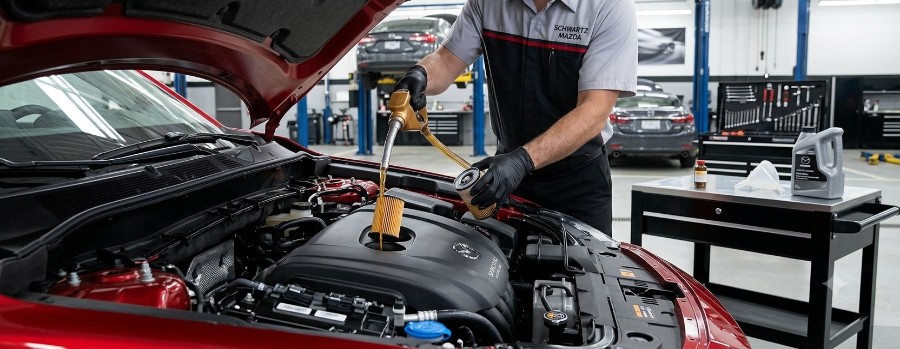
At
Schwartz Mazda Service in Shrewsbury, drivers can get help determining the appropriate maintenance schedule
for their vehicles. Here is what you should know about oil change frequency,
the factors that influence it, and the warning signs that your Mazda may need
an oil change.
How Often Does a Mazda Need an Oil Change?
There is
no single oil change interval that applies to every Mazda. The recommended
schedule depends on your model year, engine, driving conditions, and the
maintenance instructions provided by Mazda.
Many
modern Mazda vehicles use maintenance schedules that allow oil changes at
intervals of approximately 5,000 to 7,500 miles under certain driving
conditions. Some models and operating conditions may allow different intervals,
so these figures should be treated as general guidance rather than a universal
recommendation.
Your
owner's manual and vehicle maintenance monitor are the best places to check the
schedule specific to your Mazda. Depending on the model, the maintenance
monitor may account for elapsed time, mileage, and other operating factors when
indicating that service is due.
It is
also important to distinguish between normal and severe driving conditions.
Frequent short trips, extensive idling, stop-and-go traffic, dusty roads, and
repeated cold starts can place additional demands on engine oil. If your
driving habits fall into Mazda's severe-use category, your vehicle may require
more frequent oil changes.
When in
doubt, consult your owner's manual or contact Schwartz Mazda Service for
guidance based on your vehicle's specifications.
What Factors Affect Mazda Oil Change
Intervals?
Two
Mazda owners can drive similar annual mileage but need different maintenance
schedules. The reason often comes down to how and where they drive.
1.
Stop-and-Go Traffic and Frequent Idling
Repeated
acceleration, braking, and idling can make driving more demanding than steady
highway cruising. During long periods of idling, the engine continues running
even though the vehicle is not covering much distance.
If your
daily routine includes congested roads around Shrewsbury, repeated stops, or
extended periods in traffic, check whether your driving qualifies as severe use
under Mazda's maintenance guidelines.
2.
Frequent Short Trips
Short
journeys can be particularly demanding because the engine may not remain at its
normal operating temperature long enough to evaporate accumulated moisture and
certain fuel-related contaminants.
If most
of your drives involve quick errands, school drop-offs, or brief trips to
nearby destinations, do not rely on mileage alone to determine when your next
oil change is due.
3.
Temperature Extremes
Very hot
or cold weather can influence how engine oil behaves and how the engine
operates. Cold starts can be especially demanding because oil needs time to
circulate throughout the engine, while high operating temperatures can
accelerate oil oxidation.
Drivers
should follow Mazda's recommendations for the specific climate and driving
conditions they encounter rather than choosing an oil change interval based
solely on the season.
4.
Highway Driving and Heavy Loads
Steady
highway driving can be less demanding than repeated stop-and-go travel in some
circumstances. However, towing, carrying heavy loads, driving on steep grades,
or operating in other demanding conditions can increase engine workload.

If your
Mazda regularly encounters these conditions, consult the maintenance schedule
to determine whether a more frequent service interval applies.
Which Engine Oil Should You Use in Your
Mazda?
Choosing
the correct engine oil is just as important as changing it on time. Mazda
engines are designed to operate with specific oil viscosities and performance
requirements. Using an unsuitable oil can affect lubrication and may not
provide the protection intended by the manufacturer.
Engine
oil viscosity is commonly represented by a grade such as 0W-20 or 5W-30. The
numbers describe how the oil behaves at different temperatures, with the first
number and the letter W relating to cold-temperature performance.
However,
you should never assume that one viscosity grade is suitable for every Mazda
model. The correct specification can vary by model year, engine type, and
market.
Before
purchasing oil or arranging an oil change, check your owner's manual for the
required viscosity and any applicable performance specifications. If your Mazda
has a turbocharged engine, pay particular attention to the specified oil
requirements.
At
Schwartz Mazda Service, technicians can help identify the appropriate oil and
filter for your vehicle. Using the correct products helps ensure that your
engine receives the lubrication it was designed to use.
Warning Signs That Your Mazda May Need an Oil
Change
Your
scheduled maintenance interval should be the primary guide, but certain
symptoms can indicate that your engine oil needs attention.
|
Warning sign
|
What it may indicate
|
|
Oil change or maintenance
reminder
|
Scheduled service may be
due, depending on the vehicle's monitoring system and settings.
|
|
Dark or dirty-looking oil
|
Oil has collected
contaminants, although color alone cannot determine whether it needs
replacement.
|
|
Engine oil level below
the recommended range
|
Your vehicle may be
consuming or leaking oil, or it may need an oil top-up.
|
|
Unusual engine noise
|
Inadequate oil level or
lubrication problems may contribute, but other mechanical issues are also
possible.
|
|
Burning oil smell
|
Oil may be leaking onto a
hot surface or burning within the engine.
|
|
Oil warning light
|
Depending on the symbol,
this may indicate a serious oil-pressure problem requiring immediate
attention.
|
One
important distinction: an oil change reminder and an oil pressure warning are
not the same thing.
If the
red oil-pressure warning light comes on while the engine is running, safely
pull over and switch off the engine as soon as possible. Continuing to drive
with low oil pressure can cause severe engine damage. Check your owner's manual
and arrange professional assistance rather than assuming a routine oil change
will resolve the problem.
Similarly,
if you repeatedly find that the oil level is low, have the vehicle inspected to
determine whether there is a leak or excessive oil consumption.
What Happens During a Mazda Oil Change?
An oil
change involves more than draining the old oil and adding fresh lubricant. A
proper service should follow the procedures and specifications applicable to
your particular vehicle.
Depending
on the model and service requirements, the process generally includes:
·
Draining the used engine oil.
·
Replacing the engine oil filter when required.
·
Adding the specified grade and quantity of fresh engine oil.
·
Checking the oil level and inspecting for visible leaks.
·
Resetting the maintenance monitor or service reminder when applicable.
·
Checking other maintenance items as recommended by the vehicle's service
schedule.
A
technician may also identify developing concerns during a general inspection,
such as fluid leaks or other maintenance needs. Addressing these issues early
can help prevent minor problems from becoming more expensive repairs.
The
exact work performed will depend on your Mazda's condition, mileage, and
scheduled maintenance requirements.
Why Oil Filter Replacement Matters
The
engine oil filter helps capture particles and contaminants that circulate
through the lubrication system. As the filter collects debris, it must continue
allowing oil to flow at the rate required by the engine.
Replacing
the filter according to Mazda's maintenance recommendations helps maintain
effective filtration. Installing a suitable filter also matters because the
component must meet the requirements of the specific engine.
An oil
change should therefore include attention to both the lubricant and the
filtration system. Replacing the oil without addressing the filter when
replacement is due can undermine the purpose of the service.
Keep Your Mazda Maintenance on Schedule at
Schwartz Mazda Service
Regular
oil changes are among the most straightforward ways to support your Mazda's
long-term performance. The key is to follow the correct interval for your
specific vehicle, use the recommended oil specification, and pay attention to
changes in engine operation.
Whether
you drive a Mazda CX-5 for your daily commute, a Mazda CX-50 for weekend
adventures, or a Mazda3 for everyday travel, keeping up with routine
maintenance helps you care for the engine over the long term.
For drivers in Shrewsbury and nearby communities, Schwartz Mazda Service can help determine the appropriate oil change schedule for your vehicle and identify any additional maintenance that may be due.